

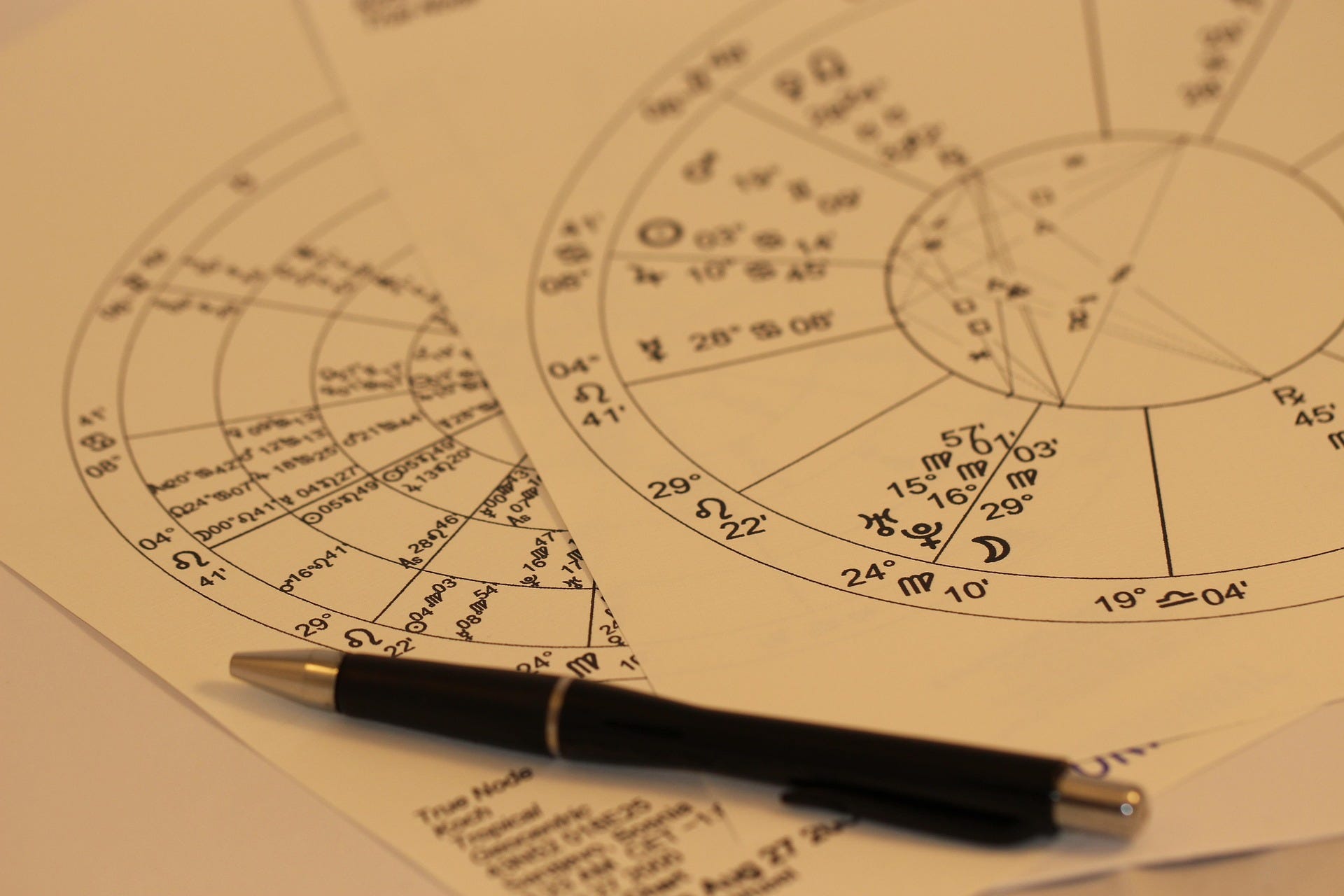
This week’s article is about the critical shift from personality to psychic structure in Developmental Astrology and it’s the last call for my upcoming course, From Personality to Development, that begins September 3, 2026. I don’t know when I will offer another intro course like this, and:
There are 2 spots left! Is one of them is yours?
Last week’s podcast How We Live Inside Projection, illustrated this very point. It was about the context of projection, rather than the content. When we think of projection, we think typically of judgments, triggers, and other local expressions, but projection is much bigger: it is existential.
We form our very worldviews and personalities around projection, mostly without realizing it. To demonstrate, I unpack one of the most fascinating and haunting celebrity charts in world history to show how much behavior was driven by structural-level projection, completely legible in the chart.
Lastly, do you want to wake up? I’m starting a group to support real meditation and inquiry. Most people learn to meditate in ways that create steady-states, not awakening, and it’s unfortunate. Real meditation is like exercise. It doesn’t always feel good and it’s not supposed to: that’s how you know it’s working. Email me with interest or questions. Two, one-hour sessions/month, begins mid-September.
One of the central problems in astrology is that astrologers routinely ask charts to tell them things they cannot reliably show them.
Someone sees Mars in Aries and says, “You’re assertive.” Venus in Pisces: “You’re romantic.” Saturn in the seventh house: “Relationships are difficult for you.”
Sometimes these statements are strikingly accurate, but sometimes they aren’t. More importantly, they confuse two very different things: the structure of a psyche and the content that eventually fills that structure. This is what Carl Jung began to see in the 1940s before he abandoned astrology to gain acceptance from science (priorities, right?).
I’ve discovered that astrology becomes far more precise when we stop asking a birth chart to tell us exactly who someone is and ask a different question:
How is this person organized?
This distinction is at the heart of developmental astrology.
Structure Is Not Content
Consider two people with Mars in the same house and same sign.
Traditional interpretation might give us a list of likely manifestations: conflict, aggression, initiative, courage, competition, sexuality, anger, injury, and so forth.
But those are possible forms of expression. They aren’t the underlying structure itself.
At the structural level, Mars describes something more fundamental: a function involving assertion, force, separation, action, and the capacity to impose oneself upon reality. The house tells us the developmental domain in which that function is operating. The sign modifies the expression like an adverb does a verb.
What somebody actually does with that structure depends upon many things the placement itself cannot tell us.
One person may become aggressive. Another may become extraordinarily disciplined. Another may suppress assertion almost completely and repeatedly encounter aggressive people instead. Another may become an athlete, surgeon, entrepreneur, activist, soldier, or someone who simply spends their weekends arguing with strangers on Facebook.
The chart hasn’t changed, but the expression has.
This is why astrological interpretation becomes unreliable when we move too quickly from structure to biography, from context to content. And then it makes a brilliant model look hit or miss, when the responsibility is on the astrologer, not the astrology.
A Birth Chart Describes Constraints, Not Outcomes
In Developmental Astrology, the birth chart describes a set of structural constraints.
It tells us something about the architecture through which experience will be organized.
Certain psychological functions are brought together. Certain developmental domains become highly charged. Some functions support one another; others create tensions that must somehow be resolved. Particular areas of life become disproportionately important to the development of the person.
But structure does not determine what gets built inside it.
Think of architecture in the ordinary sense. If I show you the blueprint of a building, you can tell me quite a lot about it. You can identify where movement is easy or constrained. You can see where weight is carried. You can identify spaces that are unusually large, isolated, exposed, or central to the design.
But the blueprint cannot tell you whether the person living there is happy.
It cannot tell you what books are on the shelves.
And it certainly cannot tell you what happened at dinner last Tuesday.
What happened to astrology is the same thing that happens to every brilliant, sophisticated system: people who cannot think systemically well reduce it to what they can understand, like reducing chess to checkers…and then forgetting chess ever existed.
People mostly try to use astrology to infer the furniture from the blueprint. You can do that, but it’s not what it’s for. You can use the back of a screwdriver as a hammer, too.
Developmental Astrology is interested first in understanding the building.
Why the Same Placement Produces Different People
This immediately explains one of astrology’s most obvious problems: people with identical placements can be radically different. They should be.
A placement is not a personality trait.
Every astrological structure develops through a particular person, family, culture, historical period, level of consciousness, set of experiences, and series of choices.
Most importantly, the person develops.
The same structural configuration can look dramatically different at different stages of maturation.
A person who initially experiences Saturn primarily as inhibition may eventually develop extraordinary discipline. Someone who experiences Mars as uncontrolled aggression may eventually develop an unusually clean capacity for assertion. A person who initially projects a psychological function onto other people may eventually recognize and integrate that function within himself.
The structure persists while its expression evolves.
This is why Developmental Astrology is developmental.
The chart isn’t merely describing what you are. It is describes something you are doing.
And some ways of doing your life work considerably better than others. Have you noticed?
The Chart Can Show You the Problem Without Telling You the Solution
This leads to a question one of my students recently asked me.
She was beginning to see the diagnostic power of the model. She could see how Developmental Astrology revealed the organization of a person’s psyche.
Her question was essentially:
Okay. Now what?
It’s an excellent question, because an accurate diagnosis is not development.
Seeing a pattern doesn’t automatically transform it, but a structural diagnosis gives us something extraordinarily valuable: it helps us locate the actual developmental problem.
Instead of saying, “You need to become more confident,” we can ask why authority is organized the way it is.
Instead of saying, “You need better relationships,” we can examine the structure through which orientation toward Self and Other are constructed.
Instead of treating anxiety, conflict, ambition, dependency, isolation, or compulsive achievement as isolated symptoms, we can ask what developmental task those behaviors may be attempting (successfully or unsuccessfully) to solve.
The chart becomes less like a personality test and more like a map of developmental tensions.
And once you can see those tensions, a very different kind of inner work becomes possible: work completely customized to the person’s specific developmental mandates.
What Astrology Can and Cannot Know
This also requires some humility about astrology.
If I look at a natal chart without knowing anything about the person, there are things I may be able to say with considerable confidence about its structure.
But there are other things I simply cannot know.
The chart may show me a powerful structural tension involving authority. It cannot necessarily tell me whether the person became a CEO, rejected authority entirely, submitted to domineering people, became domineering himself, or spent thirty years working through the problem in psychotherapy.
Those may all be expressions of related architecture.
Biography helps us discover how the structure became embodied. This is why the most compelling chart readings are not acts of psychic fortune-telling. They are investigations.
We move between chart and life. The chart helps us understand the life, and the life helps us understand how this particular person has expressed the chart.
Eventually something remarkable can happen.
You stop seeing a collection of astrological symbols.
You begin to see a psyche. This is the part of astrology I find most exciting. It’s like when Neo sees the code from inside the matrix.
At first, learning astrology involves a lot of information: planets, signs, houses, aspects, dignities, dashas, transits, nodes, and countless combinations among them.
But eventually the task changes.
You stop asking, “What does Saturn in this house mean?”
You start asking:
What is this whole system doing?
Why is this function here?
What developmental problem is being organized around this house?
Why are these planets operating together?
What is being projected?
What is underdeveloped?
What has become exaggerated to compensate for something else?
What would a more mature expression of this same structure look like?
At that point, astrology becomes considerably more interesting than personality description.
It becomes a way of investigating human development.
And that, to me, is what a birth chart can actually tell us about a person.
It cannot tell us everything.
But it may show us something even more useful than a catalog of traits: the architecture through which a human being is becoming who they are.