

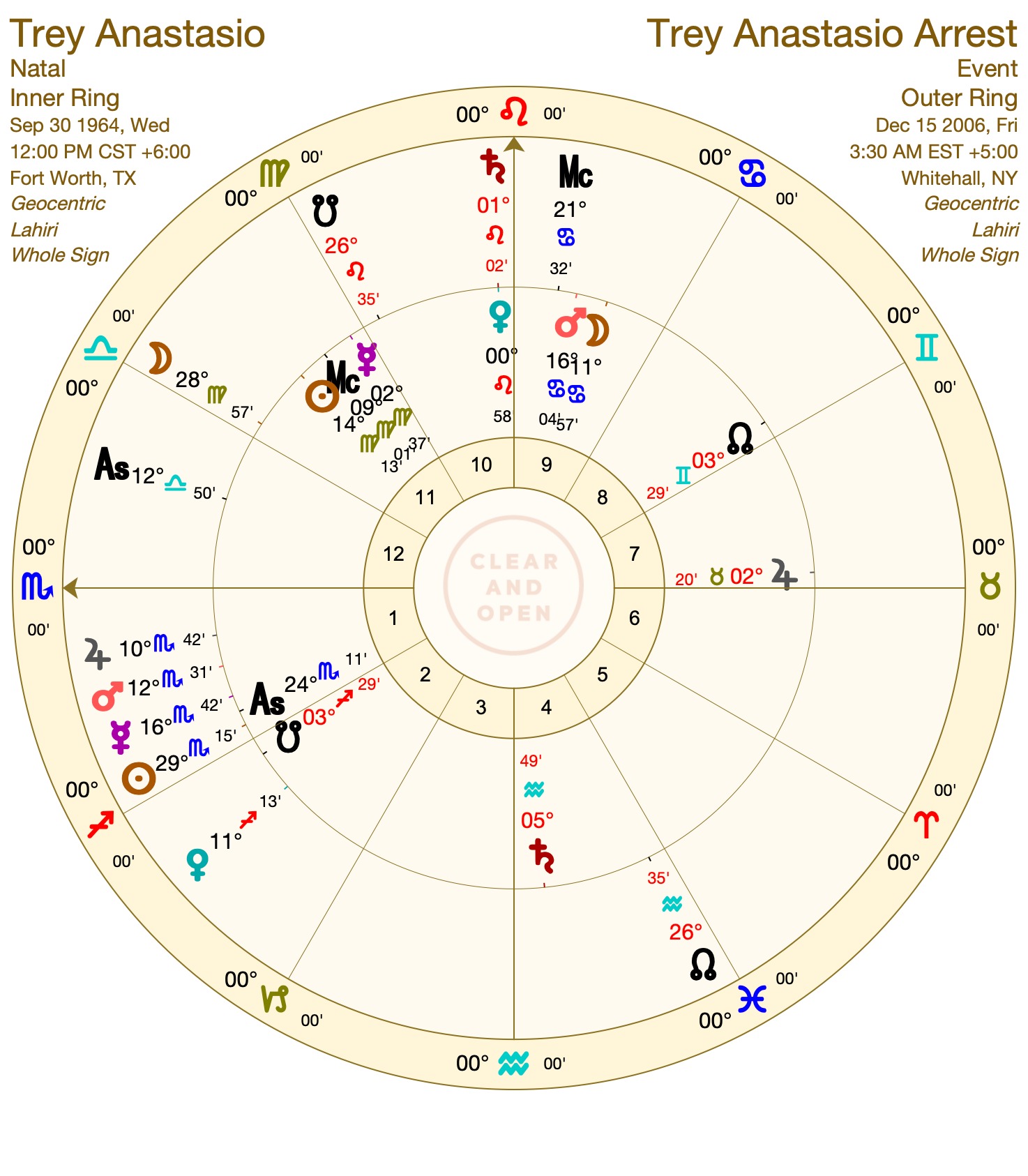
Of course, we all wish we could meet our heroes, and Trey Anastasio has always been one of mine. As his birthdate (but not time) was publicly available, I saw an opportunity to get to know him more, and stumbled into a remarkable astrological case study.
Astrology is often approached descriptively, as a language for character traits, personality tendencies, or symbolic archetypes. In such approaches, rectification (the process of determining an accurate birth time) is frequently attempted by matching a chart to a person’s perceived temperament or outward behavior. This method is unreliable. Personality is flexible, context-dependent, and easily misread. Structural events, by contrast, are not. A person may appear many ways, but they cannot experience a major arrest, a public collapse, or a sustained period of reconstruction without specific underlying conditions being present in their chart.
This study demonstrates a structural method of rectification using the case of Trey Anastasio: composer, musician, and Phish front man. The approach proceeds in three steps. First, identify non-negotiable life events that require specific domains of activation. Second, determine whether the timing system of Vedic astrology, the dasha sequence, supports those events. Third, test whether the planetary transits on the date of the event activate the necessary domains within the proposed chart. If all three layers converge, the chart is not simply plausible; it becomes structurally necessary.
A correct chart is not one that describes a person convincingly, but one that must be true in order for the events of their life to occur. This reframes rectification as a problem of necessity rather than resemblance.
The Proposed Chart
The working chart is based on a noon birth time on September 30, 1964, producing a Scorpio ascendant and a Moon in Cancer at 11°57′. This Moon placement situates the native in Pushya nakshatra, which is ruled by Saturn. In this framework, the Moon represents the system’s method of regulation: how it stabilizes itself under changing conditions. The nakshatra modifies how that regulation is executed. Pushya, as a Saturn-ruled nakshatra, introduces themes of containment, discipline, and structural support. The system attempts to regulate itself through building and maintaining structures that provide stability.
This immediately introduces a tension. The nodal axis of the chart places Ketu in the 2nd house and Rahu in the 8th. The 2nd house represents continuity: what must persist for the system to maintain coherence. The 8th house represents the opposite: what cannot be controlled and must be undergone, including crisis, loss of control, and irreversible transformation. Ketu in the 2nd weakens continuity. Rahu in the 8th amplifies engagement with instability. The result is a system predisposed toward cycles in which stability is undermined and replaced by periods of crisis or transformation.
The rest of the chart reinforces this pattern. The Sun, which functions as the organizing center of identity, is placed in the 11th house in Virgo, alongside Mercury. Virgo introduces precision and error correction; Mercury introduces differentiation and pattern recognition. The 11th house represents participation in systems at scale. Together, these placements describe a system that organizes itself through precise patterning within a collective framework. This corresponds closely to Anastasio’s role as a composer and bandleader, constructing complex musical systems in a highly collaborative and improvisational environment.
The Moon and Mars are placed together in the 9th house in Cancer. The 9th house represents the domain of meaning, coherence, and worldview. The Moon, as regulator, combined with Mars, as force and initiation, produces a system that engages meaning not passively, but actively and emotionally. This is not abstract philosophy; it is lived, embodied coherence. In the context of music, this can manifest as an intense drive to construct and inhabit a meaningful system of sound and structure.
Saturn is placed in the 4th house, retrograde, in Aquarius. Saturn represents structure, constraint, and what must hold. The 4th house represents the foundation of the system, the domain of internal stability. Aquarius introduces a different tension: a tendency to approach stability through abstraction, system-building, and detachment rather than through embodied continuity. The retrograde condition indicates that this structure is not readily available externally; it must be constructed internally and often develops unevenly over time.
The predictable failure mode here is reliance on conceptual structure that does not translate into lived stability. Under pressure, the system may attempt to organize or rationalize rather than regulate, producing a gap between understanding and embodiment. This results in instability at the foundational level, where the individual can articulate structure but cannot consistently inhabit it. When combined with other chart factors that emphasize intensity (Scorpio rising) or loss of control (early degree Rahu in 8th), this gap can map onto addictive or compulsive dynamics as structure failing to ground the system in a way that can be maintained under stress.
At this stage, the chart describes a system capable of high-level patterning, driven engagement with meaning, and attempts at structural regulation—with an inherent vulnerability to instability when internal regulation fails. None of this proves the ascendant. It establishes plausibility. The rectification requires testing against time.
The Dasha Sequence
The Moon in Pushya nakshatra places the native in Saturn Mahadasha at birth. The sequence proceeds through Mercury, Ketu, and Venus. This sequence aligns with major phases of Anastasio’s life in a way that is difficult to dismiss as coincidence.
During Mercury Mahadasha (approximately 1983–2000), Anastasio’s career as a composer develops. Mercury governs differentiation, patterning, and technical construction. This is the period in which Phish’s musical identity is formed, characterized by intricate compositions and system-level coherence. The match between Mercury’s function and the observed output is direct.
The transition to Ketu Mahadasha (approximately 2000–2007) marks a shift from construction to dissolution. Ketu removes cohesion. It disconnects the system from its organizing principles. During this period, Phish breaks up in 2004. The primary structure through which Anastasio’s identity and output were organized dissolves. This is not merely a career event; it is a structural loss of coherence. By the end of a Ketu period, the system is often unable to self-stabilize. Internal regulation is insufficient. The individual cannot generate structure from within. This condition is clearly visible in Anastasio’s trajectory leading up to the arrest: escalating instability, loss of control, and the inability to maintain continuity in behavior.
The December 2006 Arrest: Transit Analysis
The Ketu Mahadasha continues into the period of Anastasio’s arrest on December 15, 2006. This event provides the most precise anchor for rectification. An arrest of this nature requires specific structural conditions. At minimum, it requires overactivation of behavior, destabilization of internal regulation, and imposition of external consequence. These correspond to the 1st, 4th, and 10th houses respectively.
When the transits on that date are mapped onto the proposed Scorpio ascendant, they produce exactly this configuration.
A cluster of planets (Sun, Mars, Jupiter, and Venus) occupies Scorpio, activating the 1st house. The 1st house represents the system’s interface with reality: how it acts, behaves, and engages the world. Mars introduces force, Jupiter amplifies, the Sun exposes, and Venus adds relational or value-based engagement. The combined effect is an overactivation of behavior. The system is not contained; it is expressing itself strongly and visibly.
At the same time, Rahu transits Aquarius, activating the 4th house. The 4th house represents internal stability: the foundation of the system. Rahu destabilizes whatever it touches. In the 4th house, it produces internal instability, a breakdown in the system’s ability to regulate itself from within.
Simultaneously, Saturn retrograde transits Leo in the 10th house, joined by Ketu. The 10th house represents public consequence, authority, and accountability. Saturn enforces structure and consequence. Ketu removes coherence and control. Together, they produce a situation in which external authority imposes consequence in a context where the individual cannot maintain control over the outcome.
The alignment is exact: overactivation of behavior (1st house), destabilization of internal foundation (4th house), and imposition of public consequence (10th house). This is not a loose symbolic match. It is a structural requirement for an event of this type. If the ascendant were different, these same planetary positions would not map to these domains, and the event would not be supported in the same way.
The natal nodal axis adds a final layer. With Ketu in the 2nd house, continuity is already weakened. With Rahu in the 8th, engagement with crisis and loss of control is amplified. The transit activation of the 1st, 4th, and 10th houses does not create the event in isolation. It triggers an underlying structural vulnerability. The system is predisposed to instability; the transits bring it into expression; the dasha period ensures that the broader life phase supports dissolution rather than containment.
The Transition to Venus Mahadasha: Externalized Saturn and Reorganization
The arrest in December 2006 is followed almost immediately by a court-mandated rehabilitation process, including drug court supervision and a highly structured recovery environment. This transition occurs precisely at the boundary between Ketu Mahadasha and Venus Mahadasha in early 2007, a shift that is both temporally exact and structurally meaningful.
The rehabilitation process imposed after the 2006 arrest can be understood as an externalization of Saturn’s function. Because internal structure is insufficient, as indicated by natal Saturn retrograde in the 4th house in Aquarius, structure must be imposed from outside. Drug court supervision, mandatory treatment, and enforced behavioral constraints provide precisely the kind of containment that the chart cannot reliably generate internally at that time. This is not incidental, but structurally necessary. The system requires Saturn, and in the absence of an internal one, it receives external Saturn.
The transition into Venus Mahadasha introduces a different organizing principle. Venus, in this framework, represents valuation and attraction: the system reorganizes itself around what it values. Whereas Ketu removes, Venus integrates. It does not impose structure in the same way Saturn does; it reorganizes the system so that structure becomes desirable and sustainable.
In Anastasio’s case, the externally imposed Saturnian structure of rehabilitation creates the conditions under which Venus can operate. Sobriety is not simply enforced; it becomes valued. Anastasio became a public advocate of drug court and sobriety in general–unusual for a rock star at any stage. The system begins to reconstitute itself around a new set of priorities, including health, stability, and relational coherence. This is the beginning of a genuine reorganization, not merely a temporary containment.
The Reformation of Phish in 2009
The return of Phish in March 2009 marks the re-establishment of a large-scale system that had previously collapsed under Ketu Mahadasha. This event occurs well within Venus Mahadasha, and more specifically within the Venus–Venus sub-period, which is of particular significance.
In the dasha system, the Mahadasha sets the primary theme, while the Antardasha (sub-period) specifies how that theme is expressed. A Venus–Venus period represents a doubling of Venusian influence. Structurally, this corresponds to a strong emphasis on valuation, attraction, and relational coherence. The system is not merely reorganizing; it is doing so in a way that reinforces and stabilizes the new configuration.
To understand the significance of the band’s reformation, it is necessary to consider what the band represents structurally. Phish is not simply a group of musicians; it is a complex system of interaction, patterning, and collective output. In the natal chart, this corresponds to the 11th house emphasis, where Sun and Mercury in Virgo organize identity and function around participation in a structured system. When the band dissolves in 2004, that system collapses. When it reforms in 2009, it must do so under new conditions.
Venus Mahadasha provides the basis for this reformation. The system is reorganized not around compulsion or instability, but around revised values. Sobriety, which began under externally imposed Saturnian structure, becomes internalized as a Venusian preference. Relationships within the band are restructured. The conditions under which the system operates are renegotiated. This is not a return to the previous state; it is a reconstitution.
The Venus–Venus sub-period intensifies this process. Because both the primary and secondary timing factors point to Venus, the system experiences a period of strong alignment between values and behavior. This allows for the re-establishment of a complex, high-functioning system such as Phish, which requires not only technical skill (Mercury) and identity coherence (Sun), but also sustained relational stability and shared valuation (Venus).
This sequence: collapse under Ketu, enforced structure under Saturn, and reorganization under Venus, provides a coherent explanation for the observed trajectory. The arrest in 2006 is not an isolated event. It is the point at which the system can no longer sustain itself without intervention. The rehabilitation process introduces the necessary structure. The transition into Venus Mahadasha allows that structure to be integrated and valued. The reformation of the band in 2009 demonstrates that the system has successfully reorganized at scale.
Conclusion
The strength of this rectification lies in the convergence of independent layers. The natal chart provides a structure capable of both high-level coherence and destabilization. The dasha sequence aligns with the timing of formation, collapse, and reconstruction. The transits on the date of the arrest activate the exact domains required for the event. No single layer is sufficient. Together, they form a constrained system in which the observed events are not only explained but required.
From a rectification perspective, this sequence is highly constraining. It requires a chart in which Ketu Mahadasha aligns with a period of systemic collapse, in which Saturn is capable of being externalized as imposed structure, and in which Venus Mahadasha supports large-scale relational reintegration. The Scorpio ascendant with the given planetary placements satisfies these conditions in a way that alternative ascendants would struggle to replicate.
In the case of Trey Anastasio, the Scorpio ascendant is not merely plausible. It is the configuration that allows the structural conditions of his life (creation, collapse, and reconstruction) to be understood as coherent expressions of an underlying system.