

First, a quick announcement:
I recently consolidated my email list to Substack, where my podcasts are already hosted. I neglected to let you know before a scheduled podcast was released. Apologies for any confusion there.
At the moment, I publish about one podcast and one article per week, so that’s the traffic you can expect from me.
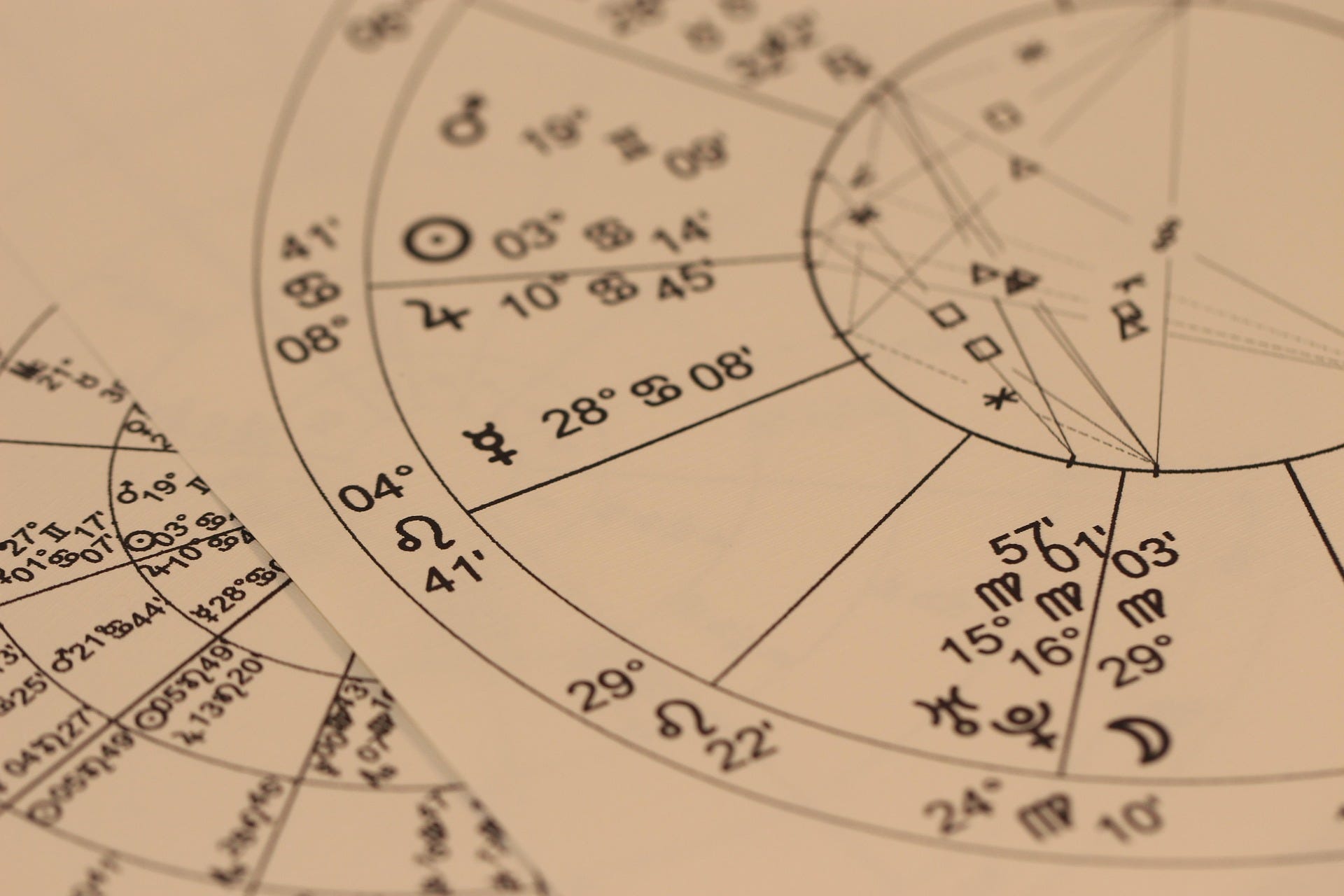
“Astrology represents the summation of all the psychological knowledge of antiquity.”
– Carl Jung, Collected Works, Volume 8: The Structure and Dynamics of the Psyche
For the past six months, I’ve been working with something that I never expected would become central to my work: astrology.
Writing that sentence makes part of me cringe a little.
Not because I’m embarrassed exactly, but because I am acutely aware of the cultural territory the word “astrology” occupies. In most educated circles, astrology sits somewhere between personality quizzes and magical thinking. Unlike other models I use, most people consider it New Age pseudo-science at best. Richard Feynman, one of my heroes, called it “dangerous.”
For most of my career I mostly disregarded astrology as a non-rigorous model that eroded individual agency that relied too much on symbolism and interpretive sleight of hand. I found the Enneagram far more effective as a typing system than astrology, and much of astrology so vague as to be barely differentiated from fortune-cookies.
Well, I mean the fortunes inside them, not the cookies–but maybe the cookies too: so bland as to make you wonder why you bothered.
But like so many things, when you get curious and investigate, it turns out there’s more to it.
I did not arrive here because I sought knowledge of cosmic destiny, soulmates, Mercury retrograde holding up text messages, or any of the other things popularly associated with astrology. In fact, one of the reasons I’ve hesitated talking publicly about this is because much of modern astrology genuinely deserves scathing criticism. A huge amount of it is vague, unfalsifiable, psychologically inflationary, identity-based, and epistemically sloppy.
So why am I talking about it now?
Because despite all of that, I gradually encountered something I could not dismiss.
I originally became interested in astrology almost accidentally while exploring developmental patterning, timing, and personality structure. My background was not at all “spiritual astrology.” It was critical thinking, developmental psychology, paradigmatic analysis, compensation patterns, governance, identity structure, and systems thinking.
Almost ten years ago, a mentor recommended an astrologer to me, a leader in the field, and out of curiosity I got a reading. It was surprisingly accurate and got my attention, but I’ve met intuitive people who could tell me things about myself that I already knew…so what?
Rigorous astrology, by the way, isn’t essentially intuitive. That’s a common misunderstanding. It’s about reading and interpreting signs that have meaning the same way words do. This is what the astrologer said, and that interested me. Somehow encoded in birth information was quite a lot of information about the personality structure. Why? How? Early trials gave me some different frames for why I was how I was, and I tested them to determine how helpful they were. It worked well enough to earn further exploration.
A year later, I received my first, forward-looking annual chart, that thematically predicts how different periods would be. I was again skeptical, but like a good scientist, I tested. “We have a couple extra minutes, any other questions?” the astrologer asked. I’d just been told broadly about my future year for the first time. The skeptic in me looked for a test.
“Yeah…” I began with a mix of curiosity and “gotcha” energy, “Can you look at May 1, 1977?” He asked me to wait while he dialed in his software to read that day, which surprisingly took him less than thirty seconds.
“You were in a forty-five day period where you would have been really accident prone.”
That was the day I was hit by a car.
He didn’t know that. Okay, um, wow. Uncanny.
But it could be a fortune-cookie coincidence. So I kept getting my annual reads and testing them against reality. They were accurate enough to come back for, but not accurate enough that I wanted to learn it myself, until recently.
The usefulness of the reads got me to pay closer attention and I learned the model enough to do some things myself. I didn’t begin with this intention, but I found myself reorganizing vedic astrology to make it more sensical. It was like when you go into the garage for something and end up spending the day reorganizing it.
So I didn’t go about learning astrology as it was. When it was accurate, I sought to understand how and why. And when it was vague and/or inaccurate, I scrutinized. I didn’t realize it at the time, but I was paradigmatically auditing astrology from a systems perspective, and used AI to turbo-charge the process. Astrology is all about pattern recognition, and AI is pattern recognition.
One important thing I learned is that a chart can tell you more than many astrologers are willing and/or able to say because they soften or generalize what they see. That pissed me off.
So, I subtracted all of that. I’m boiling down astrology to remove its impurities: no religion, no mysticism, no existential victimhood, no fate, no reincarnation – only what is experientially verifiable. I did what science would do with astrology if it could get past its judgment of it.
The result continues to blow my mind. It’s still astrology, but not the kind anyone I can find is doing.
I’ve examined hundreds of charts now and not found an exception: with my rigorously distilled and redefined terms applied in a development context, the chart reliably maps recurring developmental pressures, compensations, strengths, distortions, timing patterns, authority issues, relational dynamics, self-stabilizing strategies, and growth trajectories with an accuracy level that I cannot ignore.
I increasingly found that it explained developmental structures underlying many personality patterns the Enneagram describes well. It shows the architecture and dynamics of structurally why someone is the type they are. And amidst my research, I came across the Jung quote at the top of this article. Carl F-ing Jung?!
How do we reconcile the opinion of one of the greatest minds of psychology with the newspaper garbage I grew up with on the comics page? That’s the puzzle I went about solving, and like so many things, mass distribution diluted and distorted the paradigm. Understandably, Jung publicly abandoned astrology because it threatened the acceptance of psychology, which was itself at the time seen as pseudo-science, by western medicine, but he never abandoned his respect for it and regularly consulted with an astrologer on difficult cases.
I do not subscribe to the idea that charts reveal anything about “essence.” Astrology does not provide infallible certainty or maps of destiny. Human beings are not reducible to archetypes, and they aren’t necessary. Astrology does not remove agency, override responsibility, or give anyone magical authority over another person’s life.
In fact, one of the central reasons I became interested in reconstructing astrology is because I think many traditional approaches drift toward exactly those dangers.
What I am increasingly exploring instead is something I call Developmental Astrology.
In this framework, astrology is treated not as mystical fate but as structural developmental language encoded in the birth information for reasons that we cannot know. The chart reliably maps tendencies of function, compensation, regulation, adaptation, distortion, developmental pressure, and timing – not certainty, destiny, or ontological identity claims.
Developmental Astrology’s emphasis is not on “who you really are” in some essentialized spiritual sense. It is on developmental architecture. It’s a blueprint for your issues, themes, and challenges, and orientations for how to address them. It can answer:
What functions become overdeveloped?
Which capacities compensate for weakness elsewhere?
How do you stabilize under pressure?
What kinds of developmental lessons repeatedly emerge?
Where does authority become distorted?
How does timing alter developmental priorities over the course of a life?
What are your codependent traps?
These are far more psychologically grounded and contextual questions than most contemporary astrology asks. Development astrology does not address magic eight ball, content-based questions like:
When will I get married?
Will I have a good year?
Will I be rich?
How long will I live?
Was I royalty in a past life?
Am I with my soulmate?
What sign am I most compatible with?
On what day should I donate sesame seeds to the temple?
These questions are not necessarily meaningless, but they pull astrology toward fantasy, certainty-seeking, identity inflation, and/or externally mediated authority. These kinds of questions are not essentially what rigorous astrology seems to exist for, so such questions inevitably elicit vague/inaccurate answers, and thus reduces the credibility of the model.
In other words, astrology isn’t the tool for those question-jobs. It’s like using a screwdriver to drive a nail and thinking badly of the screwdriver. The right questions reveal developmental astrology’s power – if you have the courage to ask them.
The developmental approach is interested less in prediction as spectacle and more in developmental structure, adaptation, timing, and maturation. The goal is not to eliminate uncertainty or provide magical reassurance. The goal is to better understand the architecture through which human development unfolds.
One way I knew I was onto something was when I saw that some of my reads scared people. A development astrology read is like an X-Ray of your psycho-behaviorial structure. It’s not going to inflate your sense of self-worth, it humbles you with a stark display of your developmental challenges. Most people don’t want this, which is another reason why astrology devolved into its modern form of infotainment and feel-good support. I have no interest in that dilution, and interestingly my own chart says why.
Funny thing: in my very first read, the astrologer said I had a chart that was good for pattern-recognition and that I would probably make a good astrologer. I remember scoffing inside at the idea because astrology lacked the kind of teeth that I respect in a paradigm.
Ironically, my skepticism is one of the reasons I pursued this seriously. I never wanted to surrender rigor in exchange for wonder. I have spent too much of my life studying cult dynamics, projection, ideology, identity inflation, emotional reasoning, and unfalsifiable systems to comfortably slide into blind belief.
So the challenge became: is it possible to approach astrology without abandoning falsifiability, discernment, or intellectual honesty?
That question still matters enormously to me.
In many ways, I still feel epistemically homeless around this subject. Many skeptics dismiss astrology without deeply investigating it, while many astrologers embrace levels of certainty and metaphysical assertion that I cannot support. I’ve landed in an uncomfortable middle territory: too structurally persuaded to dismiss it, too rigorous to accept the surrounding mythology.
But at this point, hiding the work is less honest than speaking openly about it.
Over the coming months, I’ll likely begin sharing more about developmental astrology, chart structure, timing, identity formation, relationship dynamics, and the strange intersection between symbolic systems and developmental psychology. On my Human Maturity Podcast, I show how developmental astrology works using celebrity charts as part of most newer episodes. With this model included in my new direction, I suspect some people will immediately lose interest. Others may become curious. Both are fine.
What matters to me is remaining honest about what I do and do not think I have discovered.
I do not think astrology replaces science. I do not think it grants special spiritual authority. I do not think it excuses irrationality or responsibility.
But the evidence shows that Carl Jung was right: there is a real developmental signal embedded in it, and it should not be dismissed without investigation. That’s what curiosity is for. There’s nothing you need to believe in. You can easily experience it for yourself, if you can bear the questions it raises about how much free will you actually have.
What I appreciate most here is the honesty of the bridge.
Not only the bridge into astrology, but the bridge between skepticism and curiosity, rigor and wonder, certainty and direct experience.
The phrase “epistemically homeless” really landed for me. There is a stage of development where we no longer fit comfortably into the camps we once occupied, yet we are not willing to adopt a new position prematurely. It’s uncomfortable, but it also feels deeply honest.
What I hear throughout this article is not an attempt to convince people of astrology, but an invitation to investigate experience without abandoning discernment. That strikes me as a rare combination. Ironically, it is that very posture that has made me more open to astrology itself. Not because certainty was offered, but because the inquiry feels rigorous enough to deserve a closer look.
The article feels less like an arrival and more like a record of reconciliation. And perhaps that’s why it resonates. Many of us are discovering that growth isn’t always about choosing one side of a polarity, but learning how to stand in the tension long enough for a larger integration to emerge.
The piece too about “not wanting to sacrifice rigor for wonder” struck me, but from the opposite direction. For me, what I didn’t want to sacrifice was reverence, awe, and wonder—an actual tagline I used for many years. I didn’t want a more rigorous framework to flatten the mystery.
What I am finding instead is that bridging toward rigor—toward the domains of mind, will, and structure—isn’t diminishing the reverence. It’s grounding it. The structure doesn’t seem to replace the wonder; it gives it somewhere more stable to stand.
Thank you for putting words to a process that I suspect many of us are navigating in our own ways.